Showing posts with label fabric. Show all posts

Flow process chart for Mercerization

Flow process chart for Mercerization
Mercerizing is done before dyeing. Mercerized fabric is most sophisticated than un-mercerized fabric. This process also depends on the buyer requirement.

Mercerizing is done after bleaching operation. Bleaching is enough for prepared the fabric dyeing. But mercerization is done for adding some advantage to the fabric luster and strength.

Mercerizing makes fabric shinier and more colorful, and it provides the fabric stable shrinkage and fine. It is done for the sophisticated fabric.


Flow process chart for Mercerization.
Nasrin Sultana Tumpa.
Opex and Sinha Group.
Sr. Production Officer
B. Sc. In Textile Engineering
Bangladesh University of Business and Technology (BUBT)

FABRIC PREPARATION PROCESSES : YARN PREPARATION EQUIPMENT

FABRIC PREPARATION PROCESSES : YARN PREPARATION EQUIPMENT
Various types of equipment can be used for preparing fabric. The ultimate goal of any preparation process is to produce fabric that is clean and rid of all impurities that interfere with dyeing and finishing. The preparation steps can be carried out as either batch or continuous processes. The fabric may be transported as a rope or as an open sheet through the equipment. The choice is often predicated on the dyehouse itself. The distinguishing feature of batch equipment is that all of the fabric is simultaneously submerged in the liquor. The fabric is agitated by moving it through the liquor. In continuous processes, the fabric passes non-stop through compartments and/or stages so that the fabric is incrementally subjected to the action of the chemicals. The equipment used for dyeing fabrics is also suitable for preparing fabric. In this section, the equipment used to perform fabric preparation will be described.

I. YARN PREPARATION EQUIPMENT

Slashing is the process where Size is applied to warp yarns for weaving. The purpose of size is to protect the yarn from the abrasive action of the loom. The process is carried out on a Slasher and the application procedure is called Sizing or Slashing. While technically this process is not considered as a step in preparing fabric, the materials used in this operation, to a large measure, account for the bulk
of what must be removed. Because the desizing step is highly dependant on what size was used, it is deemed instructive to discuss the slashing process as well as discuss the nature of the sizing materials.

Figure 1 shows a schematic diagram of a slasher. In slashing, section beams are combined to create a loom beam and at the same time apply the appropriate size to the warp yarns. The section marked (1) is the let-off station where one or more section beams are combined and fed through the rest of the range. The warp yarns are let-off as a flat sheet and then pass through a size applicator (2) consisting of a trough containing the size formulation and squeeze rolls. The yarns pass over heated cans (3) to dry. Located at the exit end of the slasher is an arrangement of bust bars which separate each warp end from its neighbor. The individual warp ends passthrough a reed which guides the yarn onto the take-up beam. Associated with the slasher is a cooking station, where the sizing material (starch or polyvinyl alcohol) is dissolved and stored. The solution is metered to the applicator as needed to
replenish what has been taken up by the warp sheet. The chemical nature of the size will be discussed in a later section along with the conditions needed to effectively remove the size.

Fabric preparation for dyeing

Fabric preparation for dyeing

The term "Preparation" has two implications in textile processing. In greige manufacturing, it is used to describe the processes which prepare yarns for weaving and knitting. Mostly, it is used to describe slashing operations that ready warp yarns for weaving. In dyeing and finishing, the term is used to describe those processes that ready fabrics for the steps that follow, coloration and finishing. Fabric
preparation is the first of the wet processing steps where greige fabric is converted into finished fabric. The steps that follow, dyeing or printing and finishing, are greatly influenced by how the fabric is prepared. Improper preparation is often the cause of problems encountered in the dyeing and
finishing steps. Wet processing technical conferences nearly always have sessions that stress the importance of fabric preparation, seldom is there a conference without topics on how to prepare specific fabrics.

There are many different fabrics, many different plant set-ups and many different machines used in wet processing. There is no universally accepted best method for each of the wet processing steps. Nonetheless every set-up is expected to, and more often than not, accomplish the same goals. To deal with this seemingly infinite number of permutations, a fundamental understanding of what happens at each step and how to control the chemical and physical parameters becomes paramount.

The discussions that follows will deal with all of the specific steps that encompass fabric preparation. Fundamental chemical and physical concepts will be stressed. It is important for the reader to understand that not all fabrics undergo each of the steps: however, a specific fabric will be routed through those steps that are necessary to end up with a thoroughly prepared fabric. Chapter 1 will discuss the equipment used to prepare warp yarns, and the equipment used to prepare fabrics for dyeing and finishing, Chapter 2. will cover the chemistry. In wet processing it is generally recognized that the steps encompassing preparation are:

Singeing: A process where loose fibers and fuzz is burned away to yield a clear and clean fabric surface.

Desizing: A process where warp size is removed.

Scouring: A process where mill and natural dirt, waxes and grease are removed

Bleaching: A process where color bodies are destroyed and the fabric is whitened.

Mercerizing: Caustic treatment of cellulosic fabrics improving luster, water absorbance, dye yield and fiber strength.

Carbonizing: Acid treatment of wool for removing vegetable matter.

Heat Setting: Heat treatment of fabrics containing thermoplastic synthetic fibers. Stabilizes fabric by reducing shrinkage and distortion.

Describe the types of fabric? The flow chart of fabric manufacturing or weaving process?

Describe the types of fabric? The flow chart of fabric manufacturing or weaving process?

Describe the types of fabric?

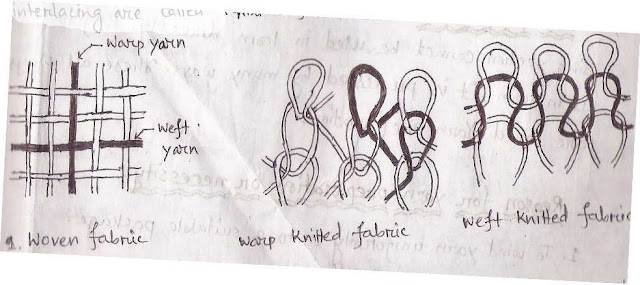
There are three types of fabric. They are –

1. Woven fabric: The fabrics which are produced by two sets of yarn by interlacing are called woven fabric. The name of two sets yarn are-

2. Knitted fabric: The fabrics which are produced by one sets of yarn by interlacing are called knitted fabric.

3. Non-woven: Here fabrics are produced by connecting yarn with gummy or bonded materials.


The flow chart of fabric manufacturing or weaving process:


Learn Basic Weaving Operation In Fabric Manufacturing

Learn Basic Weaving Operation In Fabric Manufacturing
The machine used for weaving fabrics is a loom. Before weaving yarns intended for warp must pass through such operations as spooling, warping and slashing to prepare them to withstand the strain of weaving process. These processes do not improve quality of yarns.

A. Spooling:

Yarn is wound on large spools, or cones which are placed on a rack called a creel from this yarns are wound on warp beam, which is similar to huge spool.

B. Starching:

These yarns are unwound to be put through a slashing or sizing bath. The slasher machine covers every yarn with a coating to prevent breaking during weaving process.

C. Wrapping:

The sized yarns are then wound on a final warp beam and are ready for the loom.The warp beam prepared now is then mounted on looms. Before the invention of conventional loom, back strap loom was in existence. Later on, the conventional loom replaced the back strap loom which is now-a-days not in use. The above given preparatory procedures were not followed in the back strap loom since
the fabric was prepared manually. On conventional loom, the warp beam is mounted at the back and warp yarns are conveyed to a cylinder called cloth roll, which is at the front of the loom and on which fabric is rolled as it is constructed.

The warp beam holds the length-wise yarns and is located at the back of the loom. This beam is controlled so that it releases yarn to the loom as it is needed.The Heddles are wires or metal strips with an eye located in the center through which the warp ends are threaded. The harness is the frame that
holds the Heddles in position. Each loom has atleast two harnessess. A majority of looms for regular fabrics have four to twelve harnessess and some looms may have as many as thirty-two. Harnessess
can be raised or lowered to produce the shed through which the filling yarn is passed and thus controls the pattern of weave.The shuttle move back and forth in the shed created, passing the filling yarns between the warp yarns. The reed is a comb like device that helps to pack the filling yarns into position in the woven fabric.

during weaving process.The cloth beam is located at the front of the loom and holds the completed fabric. So we can say a basic loom consists of: 1. Warp beam 2. Heddles and harness 3. Shuttle 4. Reed 5. Cloth beam

Now-a-days highly sophisticated looms are available which may have devices other than these but all the looms no matter how specialized they are, have some basic operations which are fundamental and are performed in sequence and are constantly repeated.

Fabric weaving & Difference Between Warp and Weft

Fabric weaving & Difference Between Warp and Weft
INTRODUCTION:

Weaving is the name given to the interlacing of two sets of yarns, warp and weft at right angles and the fabric thus formed is woven fabric. The warp yarns are those yarns which lie in the length direction of a fabric while it is being woven.


The weft or filling yarns are those which, during weaving are introduced between the warp yarns, across the width direction of the fabric. The warp is also known as ends and wefts as picks. The lengthwise edge of the fabric is called selvage (Self + Edge) Grain indicates a direction parallel to either the warp or filling yarn. The direction not parallel to either of these yarns is called off grain. Woven fabric will elongate most in a direction that is 45° to both sets of yarns and this direction is called Bias.

Difference Between Warp and Weft